

Much Better HCBS Waitlists (and a mess in Texas)
Buried in piles of paperwork. Trapped in endless, convoluted processes. “Sorry, you’ll have to START OVER”. Disability is about becoming a Master of Bureaucratic Judo (and learning to love Hold Music). While we feel it. It is rare that we can see it. Even better, we see it beaten back.
_____________________________
Welcome to Disability Drumbeat #3
Thank you for your patience as I work out the schedule, content, and layout for this newsletter. I’ve added a “Tidbits and Outrages” section at the end… don’t miss it.
My bottom line is that “Much Better is Possible” for children with disabilities and the disabled adults that they will become… and I hope you want to help make that change happen.
_____________________________
_____________________________
Weekly Coffee #62
Our guest Cynthia Loleng-Perez will talk about postsecondary and other programs in special education. Next up – Disability Financial Planning (what are your concerns and experiences?)
_____________________________
Waiting and Waiting for Home and Community-Based Services
Long-term services are the fragile and frayed lifeline for elderly and disabled people in the US. Instead of being part of Medicare, they are covered through Medicaid. Bad news. Moving from insurance to benefits is like moving from employment to welfare. You stop being treated as a person and find yourself considered a burden at best and a potential crook at worst. Home and Community-Based Services is the umbrella term for one of the three models that are used to deliver long-term Medicaid services in the US and it is the first stage to restoring dignity and value to its users:
Institutionalized – centralized, state-operated or state-contracted services.
Home and Community-Based Services – as it sounds, services provided by the state or a state-approved contractor in the individual’s local community.
Self-Directed – The individual selects their own service providers (in California we also have this option for disability services from the Regional Centers under the Self-Determination Program).
Unsurprisingly, a lot of disabled and elderly people and their families would prefer NOT to get their services in an institution.
Some states have other… priorities… hence, the waiting lists.
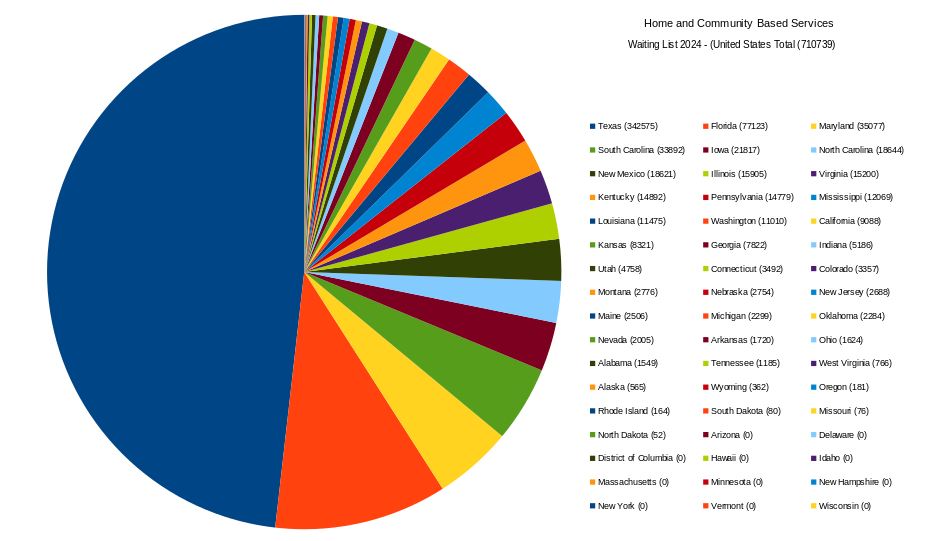
When I’ve seen sporadic articles on “The HCBS Waiting List Problem”, they begin and end with the national total of 710,739 elderly and disabled people trapped in institutionalized care or unable to access services at all. By far the best analysis of this issue comes from KFF (formerly the Kaiser Family Foundation?)… links below. They deliver the data, but dance around the problem.
The High School Laboratory of Democracy
50 states and territories. 50 strategies. In an ideal world, you’d hope that states would try things, learn from each other, and do better.
Nope.
It’s like a bad High School Science Lab:
- A couple of “A” kids being smart, but not helping anyone else.
- A bunch of folk muddling in the middle.
- And some that seem to have forgotten the point of the assignment entirely.
Everyone is doing their own thing. No collaboration. No learning. No improvement.
What a Texas Mess!
Texas at 48.2% (342,575 people) of the US total, followed by Florida at 10.85% (77,123 people), dropping further to Maryland at 4.94% (35,077 people). California sits at #14 with 9,088 people waiting.
Arizona, Delaware, DC, Hawaii, Idaho, Massachusetts, Minnesota, New Hampshire, New York, Vermont, and Wisconsin have none.
NONE!
Much better is possible indeed!
Knowing a solution exists is empowering
When I lived in San Mateo, I started researching other school districts and found the much better academic performance and inclusion numbers for Palo Alto.
It fundamentally changed the way I looked at my school district.
Why can’t I have a much better school? Palo Alto is just 15 minutes away
It is just another city on the Peninsula in California. All disabled kids (all kids!) should have a better education and educational experience.
These questions can’t be un-asked. The radically different data can’t be un-seen.
I no longer accepted the status quo when I saw a different status quo:
- Why does California have an HCBS waiting list if 11 states have none?
- Why does California have the most segregated schools for disabled students in the US (more coming soon)?
- (of course, I now ask new questions about our schools, now that I live in Palo Alto… :)! )
What do you consider unacceptable? Have you found data or stories that show that better is possible? How can we work together to make better happen faster?
_____________________________
Tidbits and Outrages**
- The Stanford Autism Center and Stanford Parenting Center just hosted a “Meet and Greet” with First Responders on 2 November. While it is great that autistic people get to meet our police and fire folk… where are we on systematic training for our police and fire folk to ensure safe, successful encounters with disabled children and adults?
- Rationing Rights in the excellent Can We Still Govern newsletter – about waiting lists and the administrative burdens to access disability services. This inspired my main topic today.
- 20% of class time on Instruction for students in segregated classrooms – A recent report with not nearly enough data reports on the amount of instructional time that disabled students in SDCs get. This is even worse than the numbers reported by the National Council on Disabilities in 2018. See also Edsource. Any experiences to share?
** I used to subscribe to “The Washington Monthly” and the editor would share short items of news and commentary in each issue. Until a better name comes along… Contributions Welcome!
_____________________________
More on Home and Community-Based Services from KFF
Medicaid Home and Community-Based Services Enrollment and Spending
10 Things About Long-Term Services and Supports (LTSS) – this is a must-read, but will depress you if you are contemplating care for your elderly or disabled family members.
A Look at Waiting Lists for Medicaid Home- and Community-Based Services from 2016 to 2023 – bottom line: no change in the number of states with waiting lists… I think it is time for a little light on this!
Medicaid HCBS Waiver Waiting List Enrollment, by Target Population and Whether States Screen for Eligibility – the data I used to build my pie chart :)