Deliberate Democracy / Disability Democracy
Disability Changemakers –
How do we work together to accelerate change to make the lives of disabled people much better?
It isn’t nearly enough for you or me to “solve” something for oursolves or our loved ones…we need to find a way to scale our efforts.
For me, the answer is Deliberate (Disability) Democracy. In short, we need to move from being passive “Democracy Consumers” to active daily “Democracy Changemakers”.
Democracy isn’t an occassional vote in a ballot box, it is something we all need to do every day.
I hope it may be an answer for you… or inspire you to share something better (and I’m working on how to explain it more clearly).
Deliberate Democracy
You’ve probably heard of the “10,000 Hour Rule” and maybe the underlying concept of Deliberate Practice. In 1993, Ericsson, Krampe, and Tesch-Romer, published “The Role of Deliberate Practice in the Acquisition of Expert Performance” laying out the concept. In short:
Deliberate practice refers to a special type of practice that is purposeful and systematic. While regular practice might include mindless repetitions, deliberate practice requires focused attention and is conducted with the specific goal of improving performance. James Clear – author of Atomic Habits
It has been applied to many topics, sports, music, medicine, business…it works and I’d like to propose that we apply it to our society’s democratic process, particularly through the lens of disability.
The Consumer Democracy Trap
We have all been seduced by the successes in our past. The appeal of democratic systems to uplift the lives of people has created massive change for good around the world. It has become so successful that even authoritarians embrace “democratic elections” as a tool for legitimacy. But, even in “healthy” democracies” we’ve seen a drift towards ritualized democratic forms overlaid on increasingly anti-democratic systems for people.
It has paralleled the enshitification we have seen in business and may have many of the same causes (I’m currently really enjoying Incorruptible by Eric Ries which looks at this problem through the lens of business).
In short, we’ve come to treat our democratic society as something to serve us like Walmart or entertain us… not something (or more importantly other people) who we have an obligation to serve.
Our leaders and political organizations seem to have fallen into a similar trap where they have little interest in increasing our daily participation and engagement but only pay attention to us (briefly) during our intermittent election rituals.
For business, Ries talks of the profit goal of “Maximizing Human Flourishing”.
Why aren’t our public and political organizations seeking the same?
Finding new ways to work these issues is imperative for all of us, but, for the greater disability community it is particularly urgent as the disability “community of communities” needs partners to flourish – there are far from enough of us to thrive or drive change on our own.
We have all been seduced by the successes in our past. The appeal of democratic systems to uplift the lives of people has created massive change for good around the world. It has become so successful that even authoritarians embrace “democratic elections” as a tool for legitimacy. But, even in “healthy” democracies” we’ve seen a drift towards ritualized democratic forms overlaid on increasingly anti-democratic systems for people.
It has paralleled the enshitification we have seen in business and may have many of the same causes (I’m currently really emjoying Incorruptible by Eric Ries which looks at this problem through the lens of business).
In short, we’ve come to treat our democratic society as something to serve us like Walmart or entertain us… not something (or more importantly other people) who we have an obligation to serve.
Our leaders and political organziations seem to have fallen into a similar trap where they have little interest in increasing our daily participation and engagement but only pay attention to us (briefly) during our intermitent election rituals.
For business, Ries talks of the profit goal of “Maximizing Human Flourishing”.
Why aren’t our public and political organiztions seeking the same?
Finding new ways to work these issues is imperative for all of us, but, for the greater disability community it is particularly urgent as the disability “community of communities” needs partners to flourish – there are far from enough of us to thrive or drive change on our own.
“We must all hang together, or assuredly we shall all hang separately” – attributed to Benjamin Franklin
Defining Deliberate Democracy
Deliberate practice is built on Purposeful Repetition with Prompt Feedback with the objective of Achieving Steady Progress
by Setting Specific Goals and Identifying Weaknesses.
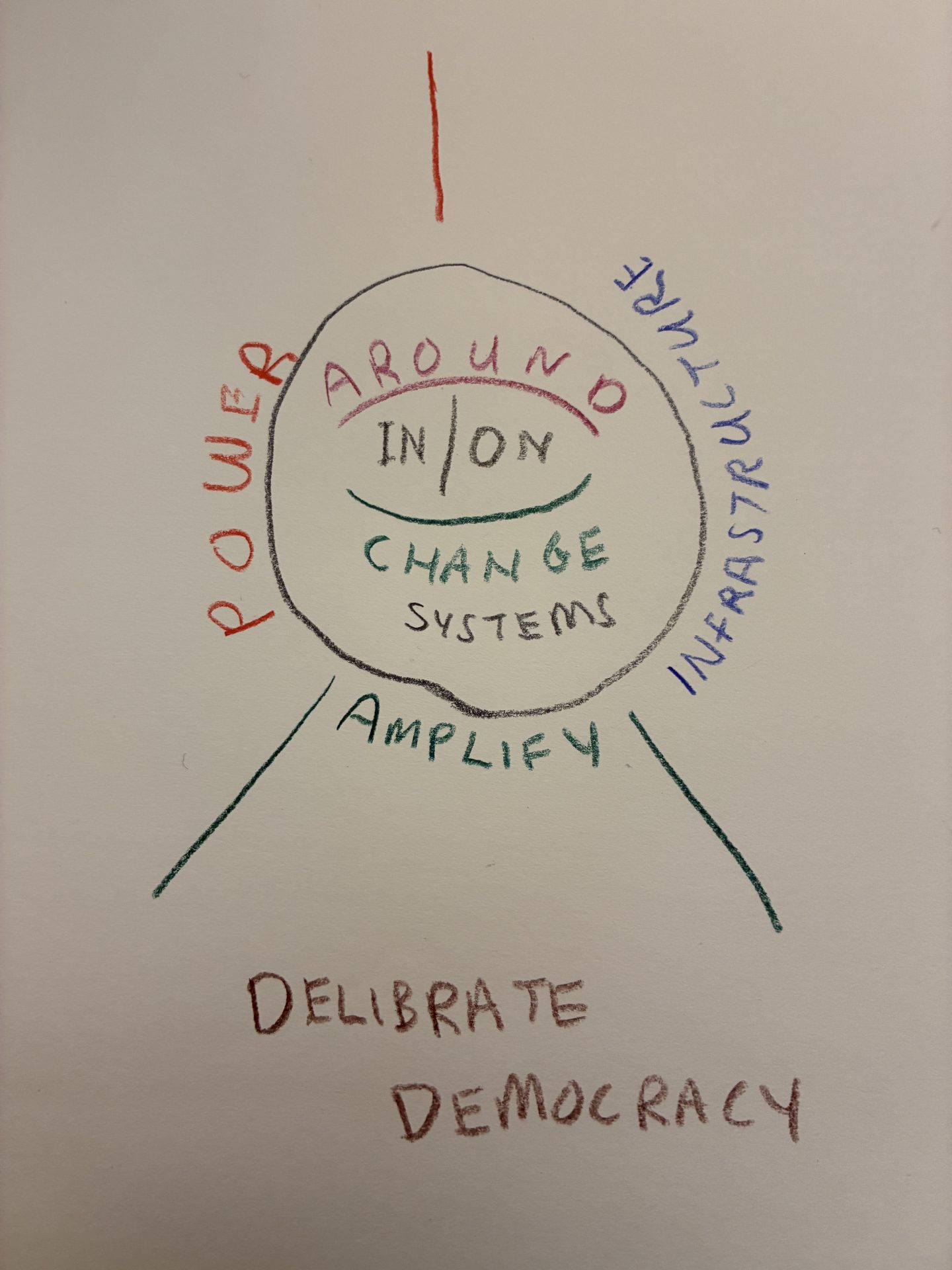
For Deliberate Democracy this means:
- Working within existing systems better
- Helping existing systems work better
- Externally augment existing systems to address their shortfalls and gaps
- Change, add, or replace systems with something better
Where our democracy is defined by its social, political, bureaucratic, market, culture, and others systems – those things that actually make up the society we live within.
Our tools to make this happen are:
- Analysis, Information, and Infrastructure – knowledge, tools, and services to make change happen.
- Amplification – spreading the word to the greater disability community and their allies and connecting them together.
- Power – leadership, followership, allyship, and organization.
Doing Deliberate Democracy
When we started out in preschool special education for my son, I drove him to school every day. I’d wait with the other special education parents for school to begin and we’d talk… and I learned SO MUCH from these (mostly Moms).
It was amazing, helpful, and disheartening at the same time.
There had to be a better way to learn and work together than happening to have the privilege of hanging out every day before school.
So I’ve tried a lot of things to try to share what I’ve learned (9 years and counting).
… with very mixed success and several notable failures (I have yet to crack the code for building an organization or growing a newsletter).
Today, my largest efforts in this area so far are my newsletter and online resource Disability Almanac, the weekly get-togethers I host here in Palo Alto, a mostly local online chat grou that I host, and my participation in local public meetings and such.
This is a big project and I’m not asking anyone else to do the same…
You and Deliberate Democracy – Try it, You may like it.
But still.
Could you share something that you’ve learned?
Some system that you’ve cracked?
A strategy that worked?
A problem that you are struggling with?
While I’d love for you to share here… can you share anywhere?
Even face-to-face or with a friend?
After all, each person we help multiplies our experience.
This is the power of books and media – radical scaling of sharing knowledge.
Or show up to just ONE public meeting a year (school board, city council, meet and greet with an elected representative)… a couple of hours a year to give your voice a chance to be heard?
If you do… let me know how it goes.
I want to learn from you.